


A generated street scene can look more convincing than the information behind it. The paving stones feel local, the evening light seems plausible, and a public building appears to belong exactly where the reader expects it. One invented banner, crowd, uniform, or weather effect can still turn an illustration into false evidence.
Local publishers need a stricter boundary than “clearly AI-made.” The useful question is what the image asks readers to believe. Kimg AI can create or edit visuals from a prompt and source material, and Nano Banana Pro can help shape an explanatory scene. The newsroom must separately control factual geometry and atmospheric interpretation so mood never impersonates reportage.
Plausible Details Create the Most Dangerous Confusion
Obvious fantasy is usually easy to classify. A symbolic collage or abstract color field does not pretend to show the reader what happened at a particular intersection. Trouble begins when an image uses the visual grammar of news photography: a familiar square, realistic people, directional light, and objects that look captured rather than proposed.
Readers do not inspect every pixel with the same skepticism. They may understand that the overall picture is illustrative and still treat a small detail as confirmed: the size of a crowd, the condition of a road, the presence of police, or the severity of flooding. A caption that says “illustration” helps, but it does not erase the claim carried by a concrete invented detail.
Before generation, the assigning editor should approve two short lines: “must preserve” and “must not imply.” The first names verified geometry or objects; the second bans unverified crowds, damage, response vehicles, weather, or signage. Those lines separate the factual and interpretive layers while risky details can still be removed from the brief instead of defended after publication.
Split Factual Geometry from Atmospheric Interpretation
Create a two-column ledger for the image. The factual side contains only verified elements that the visual may preserve: a building outline from an approved source, a road layout, an object type, or a diagrammed route. The atmospheric side contains choices that communicate tone without claiming an event: palette, texture, abstraction level, and non-literal light.
Image element | Editorial status | Allowed treatment | Reject when |
Street or building shape | Verified fact | Preserve from approved source | Geometry moves or gains invented signage |
People or vehicles | Unverified event detail | Omit or abstract | They imply attendance, response, or blame |
Color and texture | Interpretive atmosphere | Use to signal category or mood | It implies weather or damage not in evidence |
Arrows or route bands | Explanatory layer | Add from checked data outside the generated art | Placement cannot be traced to a source |
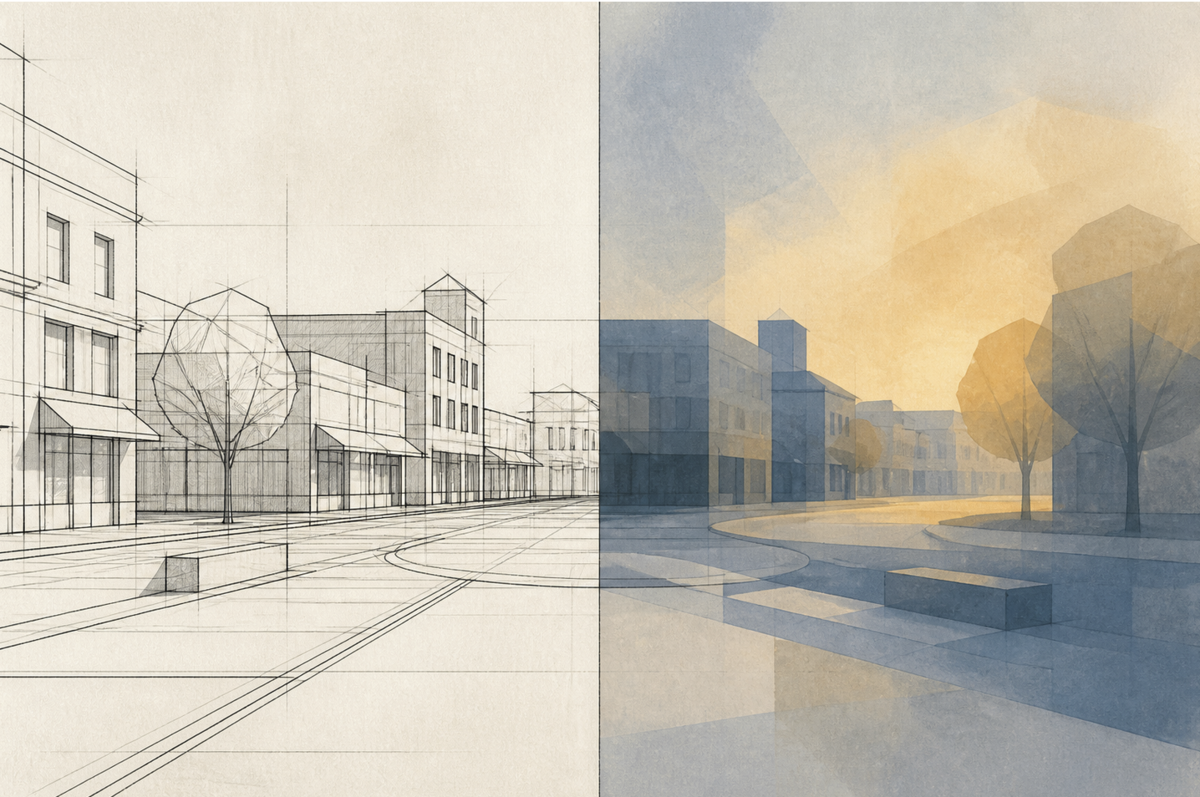
The ledger makes a subtle distinction visible. A blue-gray palette can communicate a public-service tone without depicting a storm. A simplified road band can orient the reader without constructing a realistic crash. The more documentary the rendering becomes, the less freedom the atmospheric side should receive.
Use Abstraction as a Claim Control
Abstraction is not merely a style choice. It can reduce the number of unintended factual claims. Flattening people into absent space, simplifying windows, or replacing realistic weather with a color gradient tells the reader that the image explains a topic rather than records a moment.
Keep Verified Labels Outside Generated Pixels
Names, dates, route numbers, emergency instructions, and quoted wording should be placed in a normal layout tool after the illustration is approved. Even when current image models render text well, plausible lettering is not a newsroom verification process. Keeping factual copy separate makes correction possible without regenerating the scene.
Constrain Source Images by Their Editorial Job
Kimg AI offers image-to-image generation in addition to text-to-image. A source image should enter that route with a written job: preserve the building silhouette, borrow only the palette, or establish the approximate camera direction. “Use this as a reference” is too vague for editorial review because nobody knows which drift counts as a failure.
Protect Geometry When Place Is the Subject
If location is material to the story, compare the result with the approved source at matched scale. Check the roofline, road junction, landmark spacing, and any visible public mark. Remove details the generator adds but the source does not support. The purpose is recognition without fabricated incident evidence.
Release Geometry When Place Is Not Evidence
For a general explainer about energy bills, school enrollment, or seasonal maintenance, a specific street may add risk without adding understanding. Use a non-specific composition and let color, objects, and spacing carry the topic. A scene that cannot be mistaken for a particular event may be more honest and more reusable.
When using Kimg AI, record the source, model choice, prompt, and accepted editorial role outside the platform. The Kimg AI interface exposes Public Visibility, while paid plans list private generation. Visibility settings govern the generation workflow; they do not decide whether the finished image is suitable as evidence.
Run a Cold Reader Ambiguity Check
Give the image, proposed caption, and headline to an editor who did not see the prompt. Ask three questions: what does this picture claim happened, which details appear photographed or verified, and what is merely mood? Do not tell the reviewer which answer the team intended.
A pass requires alignment. The reviewer should identify the image as explanatory or illustrative, name no invented event detail as fact, and understand the caption without extra defense. If the editor believes a generated crowd attended, a damaged road exists, or a named building displayed invented text, the image fails even if a disclosure is present.
This test also catches caption dependence. If removing the caption turns a cautious illustration into apparent documentary evidence, reduce realism or remove the risky detail. Captions should clarify the editorial role, not carry the entire burden of correcting what the pixels imply.
Write the Rejection Reason as a Claim
Record why an image was rejected in factual language: “invented vehicles imply an emergency response,” or “added lettering looks like an official notice.” This is more useful than “too AI” or “not trustworthy.” A precise reason teaches the next brief what to omit and lets an editor see whether a local repair is enough.

Publish Only the Claim the Image Can Defend
Generated atmosphere can help a local story feel specific without pretending that a camera witnessed the event. The safe route is disciplined: list verified geometry, strip out unverified incident details, keep factual text outside the generated pixels, and ask a cold reader what the picture claims.
If the answer exceeds the evidence, change the image rather than writing a longer disclaimer. The strongest local-news illustration is not the most photorealistic one. It is the one whose visual claim remains exactly as narrow as the reporting behind it.